
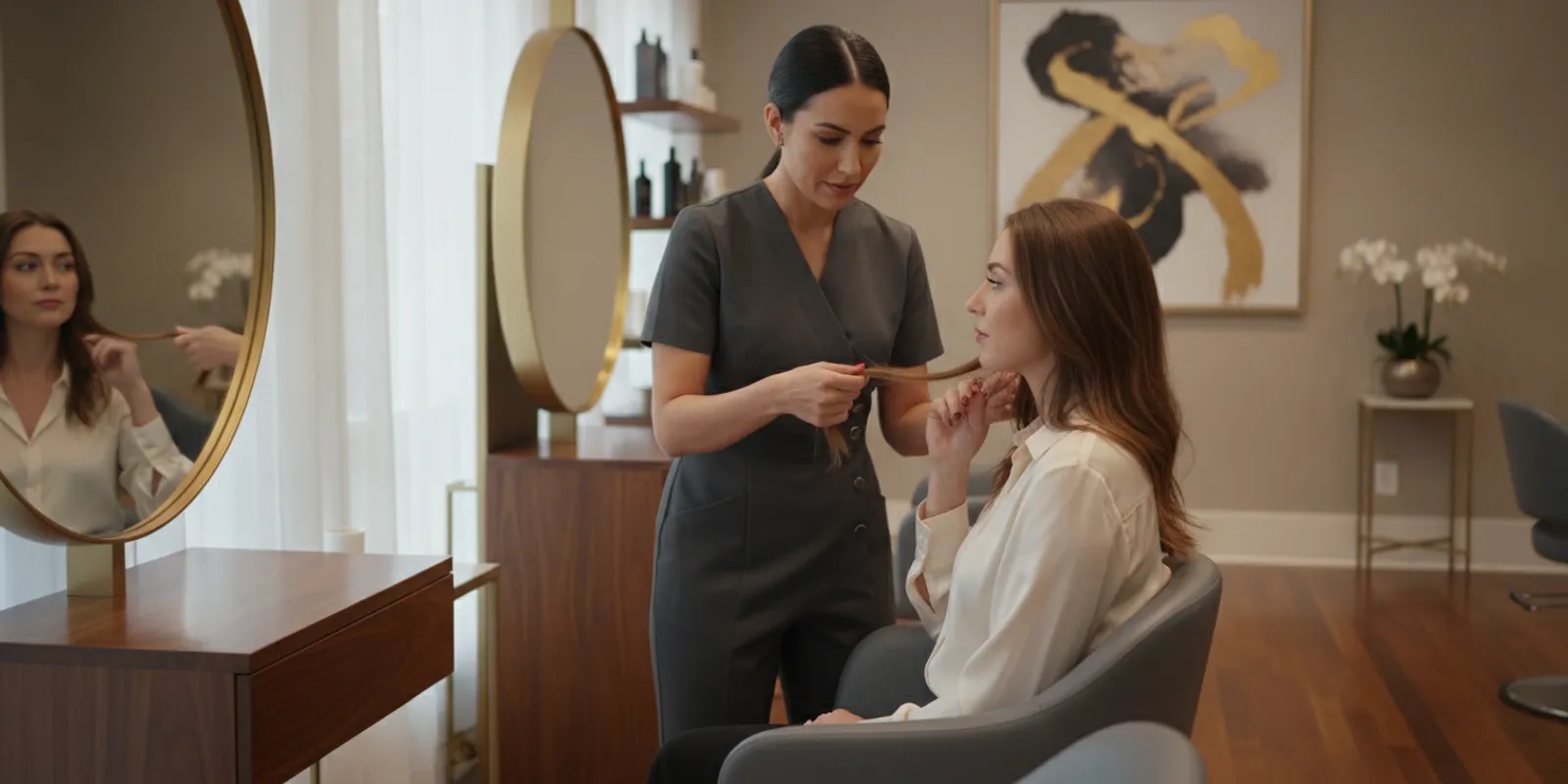
When comparing a haircut vs trim, the key difference is the goal: a trim generally maintains an existing shape and removes a limited amount from the ends, while a haircut can reshape the silhouette, alter layers, or create a more noticeable change in length. The words alone do not set a universal measurement. Explain what you want to preserve and what you want to change so your stylist can recommend a plan that fits your hair and routine.
Request a personalized haircut consultation
What is the difference between a haircut and a trim?
A trim usually means tidying the ends while keeping the haircut’s essential outline. If you like your length and shape, but the perimeter looks less defined or the ends feel rough, a trim may be the maintenance you have in mind. The stylist works with the existing design rather than starting with a substantially different one.
A haircut can also be a maintenance visit. It may mean a light refresh, a rebalanced outline, or a substantial style change. The important distinction is not whether scissors are used—both appointments involve cutting—but whether the plan is intended to maintain the current shape or change it. A small adjustment to the front can be a haircut conversation, while removing a modest amount from the ends can be called a trim.
There is no single number of inches that separates the terms. One client may describe a small clean-up as a trim, while another may use the same word for a larger amount. Before the appointment, consider what “a little” means to you. At the chair, point to a length or state a maximum amount, then ask the stylist to confirm the plan before cutting.
| Your priority | A trim may suit you when… | A haircut may suit you when… |
|---|---|---|
| Keep the silhouette | You like the outline and want to neaten its ends. | The outline needs to be redesigned or rebalanced. |
| Change length | You want a limited clean-up and to retain most of your length. | You want a clear shift in where the ends fall. |
| Adjust layers | You want existing layers refreshed in their current arrangement. | You want new layers, a different placement, or a changed weight distribution. |
| Maintain bangs | You want the same fringe shape kept at a manageable length. | You want a new fringe shape, density, or transition. |
| Address uneven ends | The perimeter needs a modest tidy-up. | The shape or visible breakage calls for a broader discussion. |
How should you decide whether to maintain or change your shape?
Start with the shape you see in the mirror, not the name of a service. Ask yourself whether you still like the outline when your hair is worn as you usually wear it. If the answer is yes and the main concern is the ends, describe a maintenance trim. If you keep tucking away the same pieces, feel that the outline is too heavy, or want a different balance around your face, explain that you are considering a shape change.
A useful test is to name one thing you want to keep and one thing you want to improve. For example: “I want to keep the length, but make the ends look more even,” or “I like the back, but I want the front to blend more softly.” This gives the stylist a clear starting point without requiring you to know technical cutting terms. It also makes it easier to identify whether your priority can be met by maintaining the existing outline or requires adjustments to its design.
A change does not have to be dramatic to count as a haircut. A subtle adjustment to the perimeter, a softer front, or a different placement of layers may be all you want. Conversely, the word “trim” does not guarantee that only a tiny amount will be removed. If preserving length matters, state that clearly and agree on the amount before the service begins.
For examples of finished looks, browse the salon gallery and notice what appeals to you: the line, the movement, the length, or the way pieces frame the face. A reference image is most useful when you identify the specific feature you like. It can open a conversation; it cannot promise that the same result will look or behave identically on different hair.
Try looking at the shape from more than one angle before you decide. The front may feel long while the back still holds the outline you like; the sides may seem bulky even though the ends look neat from behind. A mirror check in your usual part and your usual styling can help you separate a length concern from a balance concern. If you are unsure, describe what catches your eye and let the stylist assess whether it is a perimeter issue, a layer issue, or a preference for a new silhouette.
How much length do you want to keep?
Length is often the clearest practical boundary. If your goal is to maintain long hair, say that retaining length is important and explain whether you want only the ends cleaned up or a specific amount removed. You can point to where you want the hair to fall, such as at the collarbone or above the shoulders, while recognizing that the final shape also depends on the existing cut and how the hair sits.
When you want to move from one general length to another, plan for a haircut discussion. Going from long hair to shoulder length, for example, is not merely a matter of tidying the ends: the stylist may need to create a balanced outline at the new length. If the desired result includes layers or face-framing pieces, those choices should be discussed at the same time rather than assumed to follow automatically from removing length.
Try describing a range and a priority. “I would like the ends to sit around my shoulders, but I do not want to go shorter than that,” is more actionable than “take off whatever you think.” If you are undecided, say what you are comfortable exploring and ask what the options would look like. You can also ask the stylist to show the proposed amount before cutting, so you have a shared understanding of the plan.
For someone growing out a style, a trim may help maintain a deliberate outline, but it also removes length. There is no need to cut on a fixed calendar if the shape and ends are working for you. Think about what you see and feel now, how you style your hair, and whether a clean-up supports your longer-term goal. A maintenance visit should serve that goal rather than become an automatic appointment with no clear purpose.
It can help to distinguish your ideal length from your firm boundary. Your ideal might be to keep nearly all your current length, while your firm boundary is not to go above a certain point. Communicate both. That lets the stylist discuss a cautious option and a more complete tidy-up without guessing how much flexibility you have. If you have a special event, travel, or another date in mind, mention it so the plan can account for how you want the hair to look during that period.
When is a trim enough for split ends?
A trim may be appropriate when the ends are the main concern, the affected area appears limited, and you still like the overall cut. Tell the stylist what you have noticed: perhaps the ends look frayed, the perimeter feels rough, or the outline seems less even. Then explain how strongly you want to preserve length. The stylist can assess the visible condition and discuss what amount of removal could create a cleaner finish.
Do not assume that the word “trim” means every visible sign of damage can be removed while keeping all the length. If roughness or breakage extends higher than the small amount you hoped to remove, the stylist can explain the trade-off between preserving length and changing the appearance of the ends. You can ask what might be addressed in this appointment, what would require a more substantial cut, and whether the proposed plan aligns with your priorities.
It is also reasonable to ask what the stylist means by a clean-up before the service starts. Does the plan follow the existing perimeter? Will it include reshaping the front or layers? How much length is expected to come off? These specific questions prevent a mismatch between an intention to maintain the cut and an expectation of a new silhouette.
Cutting the ends does not make hair grow faster. A trim changes the visible length and shape; it does not change the rate of growth at the scalp. It may make the perimeter look more polished, which can be satisfying, but that is different from accelerating growth. If retaining length is your priority, discuss that goal directly instead of relying on a trim to affect growth.
Keep your description observational rather than diagnostic. Instead of deciding that all ends need to come off, point out where you notice roughness, tangling, or an uneven-looking line. If the ends feel different after styling or seem more noticeable in certain light, share that detail as well. The stylist can examine the hair and discuss realistic options. A conservative plan may preserve more length, while a broader reshaping may create a more even-looking outline; neither should be assumed without a conversation about your priorities.
How do bangs change the appointment?
Bangs can have a maintenance rhythm and shape of their own, so separate that request from the rest of your hair. If you like the fringe and only want it kept out of your eyes, say that you want to maintain its current shape. Point out where you want it to sit and explain how you wear it—straight, swept to the side, or parted—because those habits help clarify the result you expect.
A fringe change is a broader design decision. Moving from a full fringe to a softer or longer shape, changing its density, or blending it into new face-framing pieces can alter the overall impression of the cut. Bring a photo if you have one, and discuss how much daily styling you are comfortable doing. Ask how the fringe will relate to the rest of the haircut as it grows out.
If you want only your bangs adjusted, make that explicit when scheduling or contacting the salon. Do not assume that “a trim” means the entire haircut will be maintained, or that a bang clean-up necessarily includes the perimeter and layers. Being precise about which area you want addressed helps everyone understand the scope of the visit.
Think about the way bangs behave during an ordinary day, not only how they look right after styling. Do you tuck them back, wear a side part, or prefer them to fall forward? Tell the stylist whether the current fringe gets in your eyes or separates in a way you do not like. A tiny length adjustment and a change in direction or density are different goals, even if both are described as a bang trim. Discuss those goals separately from what you want done to the rest of your hair.
How do layers affect the choice?
Refreshing existing layers is different from creating a new layer pattern. If the current movement and placement work for you, but the ends need a tidy-up, ask whether a maintenance trim is suitable. If you want more movement, less weight, shorter layers, or a different balance between the top and bottom, describe the change you want rather than requesting “layers” without specifying the effect.
Layers can change how the hair’s weight is distributed and how the silhouette reads. A client who wants to keep a strong, blunt outline may not want the same plan as someone who wants a softer, more graduated shape. The right discussion includes where you want movement, which areas you want to feel fuller or lighter, and how you typically wear your hair. The stylist can then assess how those preferences relate to the current cut.
Think about the front separately from the back. You may want the back length preserved while adjusting pieces near the face, or you may want the entire outline to feel lighter. Say what you want to keep, and name the area that feels out of balance. This makes a haircut conversation more specific and helps distinguish a small perimeter refresh from a more considered reshaping.
Use concrete descriptions of the effect you want. “I want movement around my face” could mean shorter pieces, a softer transition, or a different parting shape. “I want less bulk” could refer to the sides, the area near the crown, or the bottom edge. If you point to the location and explain when you notice the issue, the stylist has more useful information than a general request for layers. You can also say what you do not want, such as losing the solid line at the ends or adding a short layer that would need daily styling.
How do texture and styling habits guide the plan?
Texture influences how a cut behaves once it is dry and worn in your usual way. Straight, wavy, and curly hair can show different movement and apparent lengths, and density can affect how a shape feels. That does not mean one texture requires one particular service. It means the stylist should understand how your hair naturally falls and how you want to wear it before deciding whether a simple maintenance plan or a changed shape better serves your goals.
Describe your ordinary routine honestly. Do you air-dry, diffuse, blow-dry, or use hot tools? How much time do you want to spend styling on a typical day? A cut that looks appealing after a salon finish may need a different conversation if your everyday preference is to let your hair dry naturally. Sharing that preference helps focus the plan on a result that fits your life, not only a moment in the chair.
Also mention what you notice between appointments. Maybe the ends flip outward, the front falls into your eyes, or the shape feels full in one area and flat in another. These observations are more useful than trying to diagnose the technique yourself. A stylist can assess the current cut and talk through whether maintaining it or changing its balance is likely to match what you describe.
If you have a significant change in mind or are new to the salon, a personalized consultation can align expectations before cutting. Bella Rinova has served Houston since 1999 and offers hair services as part of its full-service salon. You can review the hair services available, then bring your questions about length, shape, and styling habits to a discussion with the team.
Houston’s humidity and changing weather can affect how you choose to wear your hair from day to day. That is one more reason to explain your real routine rather than requesting a shape based only on a finished reference image. If your hair expands, bends, or loses a smooth finish when you step outside, say what you notice and whether you prefer to work with its natural movement. The goal of the consultation is to discuss a shape that makes sense for your hair and habits, not to promise that a cut will behave identically in every condition.
What should you share about your hair history?
The current outline may reflect more than one past haircut. If layers have grown out at different rates, if a previous change left a shape you are still adjusting to, or if breakage has made one area appear shorter, mention it. The more clearly you explain what happened and what you want now, the easier it is to plan a realistic next step. You do not need to know the name of an old technique to describe its effect.
Hair color and chemical-service history may also be relevant when they affect the feel or appearance of the hair. If you have had recent color work, smoothing, or another service that changes how your hair behaves, share that context. The point is not to turn a cut consultation into a diagnosis; it is to give the stylist a full picture of the hair being considered and the result you want.
Bring one or two reference images rather than a large collection of unrelated looks. Choose images with a shape or length you like, and be ready to say why. You might like the soft front pieces in one image and the overall length in another. Distinguishing those details helps prevent the photo from being treated as a single all-or-nothing instruction.
You can also bring a current photo of your own hair when it is worn in a typical way. A photo can help you explain what you mean by “too heavy” or “not sitting right,” especially if the issue appears after you leave the salon and style it yourself. Use it as a reference for the conversation, not as a substitute for an in-person assessment.
It may be useful to remember what you liked or disliked about your last haircut. Did the outline hold its shape as it grew? Were the front pieces easy to style? Did you need more time each morning than expected? Specific feedback helps the stylist understand which parts of the previous plan worked and which did not. If a particular length felt uncomfortable or a layer kept falling forward, describe that clearly so the next plan does not repeat an unwanted feature.
How can you describe the result clearly?
You do not need to speak in salon terminology. Plain descriptions of length, shape, and routine are often enough to start a useful conversation. Consider using a simple structure: what you like, what you want changed, and what you want to avoid. For example: “I like the length and want to keep it. The ends look uneven, and I would like a tidy outline. Please check with me before taking more than a small amount.”
- Length: Say where you want the ends to sit or how much you hope to preserve.
- Shape: Explain whether you want the same outline, a refreshed version, or a different silhouette.
- Specific areas: Mention bangs, face-framing pieces, layers, or the back separately.
- Condition: Describe what you see at the ends without assuming how much needs to be removed.
- Routine: Share your natural texture and how much styling you usually do.
- Boundaries: Identify the shortest length or biggest change you are comfortable with.
Then ask the stylist to repeat the plan in practical terms. If you hear “we will take off the ends and soften the front,” confirm what that means for the length and shape you care about. A brief check-in before cutting gives both of you an opportunity to clarify assumptions. If the plan sounds different from what you intended, pause and discuss alternatives rather than hoping the result will somehow match.
It can help to prioritize if your goals compete. For instance, you may want to remove all visibly uneven ends while keeping as much length as possible. Ask which priority would require the greater compromise, and what a conservative option would look like. You can then decide whether to start with a smaller adjustment or make a more noticeable change in one appointment.
For a clear consultation, try a three-part sentence: “I want to keep ___; I would like to change ___; I do not want ___.” For example, “I want to keep the length at my shoulders, I would like the front to feel less heavy, and I do not want short layers at the crown.” This wording gives the stylist a goal, a specific concern, and a boundary. It is especially helpful if a reference image shows several features but only one of them is important to you.
How can you compare two possible plans?
Sometimes the stylist may present more than one reasonable approach. One plan might preserve most of the length and maintain the current silhouette; another might remove more length to create a cleaner outline or a different shape. Rather than deciding based on the label “trim” or “haircut,” compare the expected outcome and the trade-offs.
Ask what each option changes and what it preserves. Does it alter only the perimeter, or also the layers and front? Where will the ends fall? Will the stylist be following the current shape or creating a new one? Which option is more consistent with your daily routine? These questions turn a vague choice into a comparison of visible, practical results.
For example, imagine that your hair is long, the ends feel dry, and you like the overall silhouette. A conservative plan might focus on the perimeter and keep most of the length. If the ends appear uneven at multiple points, a second plan could involve reshaping the outline. The stylist can explain the difference; you can decide whether the cleaner shape is worth the additional length change.
In another case, perhaps your length is acceptable but the front no longer blends with the rest. A trim of the perimeter alone may not address the concern. A plan that adjusts the front pieces could better meet the goal, even if the change is modest. The service name is less important than agreeing on precisely which sections will be changed.
Make sure the comparison includes your priorities, not only the stylist’s technical options. If keeping length matters most, say so. If a particular outline is more important than retaining every inch, be candid about that too. A customized plan should reflect what you value and what the stylist observes about your hair at the appointment.
Here is a practical way to evaluate a recommendation: write down the result, the amount of change, and the maintenance implication for each option. A perimeter clean-up might preserve the current style but leave a concern about layers unchanged. A more comprehensive shape adjustment might address those layers but alter the way the hair falls around the shoulders. This simple comparison keeps the discussion centered on outcomes. It also makes it easier to decide whether you prefer a gradual approach now or a more complete change in one visit.
What should you ask before the first cut?
A few direct questions can make the appointment feel clear and collaborative. You might ask: “How much length do you expect to remove?” “Will you be changing the layers or only cleaning up the ends?” “How will this look when I wear my hair naturally?” “Can we start conservatively and reassess?” The best questions are those connected to your specific priorities.
If your request involves bangs or face-framing, ask how those pieces will connect to the rest of the shape. If you want to grow out a style, ask what maintenance would preserve your intended direction rather than resetting the shape. If you have a reference image, explain which feature matters most. These conversations help establish a shared plan without requiring you to dictate every technical detail.
It is also appropriate to ask for a moment to reconsider when the proposed amount feels larger than expected. A stylist can explain why the recommendation differs from your first idea, and you can decide whether to proceed, adjust the plan, or keep the change more limited. Clear communication is especially useful when length has been a long-term goal.
For appointment details or to discuss what kind of visit fits your goal, use the salon’s contact page. If you are comparing service options, the broader salon and spa services page provides an overview of the salon’s offerings. Choose the path that helps you frame your question before the appointment.
Before booking, make sure the visit you request matches the scope you have in mind. A bang-only maintenance request is different from a consultation about changing the whole silhouette. If you are considering a major change but are unsure what to ask for, say that when you contact the salon; it gives the team an opportunity to understand the nature of your request. Share relevant details, such as whether you want to keep most of your length or are open to a new shape, so the appointment can begin with an informed conversation.
How should you plan a trim while growing out a haircut?
Growing out a cut can make the line feel less intentional before the hair reaches the next length you want. A maintenance trim may help tidy the perimeter, but it also removes some length and may affect the time it takes to reach a goal. Before booking, decide whether the current shape is bothering you enough to justify a clean-up and how much length you are prepared to remove.
Tell the stylist where you are trying to go, not only what you want fixed today. If you are growing a bob into a longer shape, for example, the goal might be to keep the back and front progressing in a balanced way. If you are growing out layers, you may want to preserve length while gradually softening differences. The actual approach depends on the current cut, so explain the destination and ask how a maintenance visit could support it.
It can be tempting to request a very small trim without discussing unevenness or old layers. If the shape has grown out in a way that bothers you, a tiny removal may not create the result you expect. A frank conversation about the trade-off helps: maintain as much length as possible, or adjust more now to make the silhouette feel intentional. There is no need to choose before the stylist assesses the hair.
Keep a record of what was agreed if you are working toward a gradual change. Note the target length, what was adjusted, and what you would like to preserve next time. This is especially helpful when you do not want each appointment to become a new redesign. The goal is continuity: a plan that respects both the current appearance and the longer-term direction.
A simple growth-out plan has three parts: the shape you are moving away from, the length or outline you hope to reach, and the features you want to preserve along the way. For instance, someone growing a shorter layered cut might want to keep the neckline tidy while allowing the top layers to catch up. Another person may want to grow a fringe into face-framing pieces without changing the rest of the length. These are different maintenance conversations, even though both people may ask for a trim. Ask how a proposed adjustment supports the destination, and be clear if your immediate preference is to avoid losing length.
How do you choose when you are still unsure?
Uncertainty is a reason to talk through the options, not a reason to guess at a service label. You can say, “I am not sure whether this needs a trim or a different shape. I want to keep the length, but I do not like how the front sits.” That gives the stylist a concrete concern and leaves room to evaluate the hair before settling on a plan.
It may help to rank your goals. Put them in order: preserving length, removing uneven ends, changing the front, reducing weight, or simplifying styling. If the first goal is non-negotiable, make that clear. If you are willing to trade some length for a more balanced outline, explain that too. Priorities give the consultation a useful frame when several outcomes seem appealing.
You can also ask what the smallest meaningful change would be. A conservative first step can be useful when you are apprehensive about a major change, while a more decisive cut may be appropriate if you are ready for a new silhouette. The stylist can explain what each choice is likely to address. You remain in control of the amount and scope you approve.
When considering a larger change, allow time to discuss the result, rather than treating the appointment as a quick end clean-up. A different length or shape may affect the way you style your hair and how often you want to maintain the outline. Thinking through those practical details is part of choosing a cut that suits you beyond the salon.
If you cannot decide between two reference looks, do not feel that you must choose one before asking for advice. Identify the features you like in each. You might prefer the length in one image and the softer front in another. A stylist can discuss whether those details can work together with your current hair and routine. This turns indecision into a useful set of preferences instead of a vague request to “make it look like both.”
What common misunderstandings can you avoid?
The first misunderstanding is that a trim always means a fixed small amount. It does not. The term is interpreted differently, so state the amount or end point that matters to you and ask for confirmation. That simple step is more dependable than assuming you and the stylist use the word in exactly the same way.
The second is that a haircut must be a dramatic transformation. A haircut can involve a subtle change to the outline or a thoughtful adjustment to the front. You can ask for a modest style update and still have a haircut conversation. The label does not dictate how bold the final result should be.
The third is expecting a trim to make hair grow faster. It does not alter growth at the scalp. A clean perimeter may look healthier or more finished, but the visible improvement is not the same as a change in growth rate. If your main goal is length retention, discuss how much to remove and why.
The fourth is assuming split ends can be addressed without considering how far the visible damage extends. A small clean-up may fit some situations; other concerns may call for a discussion about a different amount or outline. Let the stylist assess the hair and explain options rather than deciding in advance what the ends require.
Finally, a reference photo is not a complete instruction by itself. Point to the length, fringe, layers, or outline you like. Your own texture, density, current cut, and styling habits are part of the conversation. A photo helps communicate taste, while a personalized assessment helps translate it into a practical plan.
Another common mix-up is assuming that a trim covers every area that feels overdue. A request to tidy the ends may not include reshaping the fringe, reworking layers, or changing face-framing pieces. State every area you want considered. If your request has several parts, have the stylist repeat what is included before the service starts. That shared summary avoids relying on assumptions about what a service label covers.
How can you make the appointment feel collaborative?
A strong consultation is a two-way conversation. Bring your preferences, questions, and boundaries, then listen to the stylist’s assessment of the existing shape. You do not need to arrive with a perfect technical plan. The stylist’s role is to understand your goal and discuss an approach; your role is to say what feels right, what concerns you, and what you are willing to change.
Be specific about everyday outcomes. “I want it to look polished” can mean a clean blunt line to one person and soft movement to another. Explain whether you want hair to sit neatly without much effort, whether you enjoy styling, and which areas frustrate you. Concrete examples create a better starting point than broad adjectives on their own.
Listen for the difference between what can be achieved by tidying the existing shape and what requires changing its structure. If the stylist recommends a haircut when you expected a trim, ask what part of the outline needs attention and how much length would be affected. If the recommendation is a trim but you hoped for more movement, clarify whether the proposed maintenance would address that goal.
Before the service begins, summarize the shared plan: what stays, what changes, and what length boundary you have set. This short check can prevent misunderstandings and give you confidence that the appointment reflects your wishes. If your priorities change during the conversation, say so before the cut starts.
Think of the conversation as agreeing on a result, not choosing the perfect word. It is entirely reasonable to arrive saying “I thought I needed a trim, but I am open to your assessment.” You can ask for an explanation of the proposed shape in everyday language and confirm whether it addresses the issue you described. You do not need to approve any change until you understand its scope and feel comfortable with the plan.
What should you remember when choosing?
A trim is generally a way to maintain an existing haircut; a haircut can maintain, reshape, or substantially change it. But the name alone cannot determine the amount removed or the exact result. The useful questions are whether you like the current silhouette, what you want to preserve, which areas you want to alter, and how much length you are comfortable losing.
When your goal is a tidy perimeter, explain that you want to keep the existing shape and agree on a length boundary. When you want a different outline, new layers, a changed fringe, or a noticeable length shift, describe the new result and give the stylist room to assess how to create it. If you have concerns about ends, texture, or your hair’s history, include those details in the conversation.
For a personalized plan, you can review Bella Rinova’s haircut and styling services, learn more about the salon through its about page, or contact the team with your questions. The right appointment is the one whose plan matches your priorities—not simply the label you choose when booking.
Contact Bella Rinova to discuss your haircut
Frequently asked questions
Does a trim make hair grow faster?
No. Cutting the ends does not change the rate of growth at the scalp. A trim can tidy the visible perimeter or maintain a shape, but it does not speed up growth.
How much hair comes off during a trim?
There is no universal amount. Explain how much length you want to preserve or where you want the ends to sit, and ask the stylist to confirm the plan before cutting.
Can I ask for a trim if I want a new style?
You can describe your goal in your own words, but a new silhouette, substantial length change, or different layer placement is a broader haircut discussion. Explain the result you want and ask what changes it would involve.
Should I get a trim or haircut for split ends?
It depends on the visible condition of the ends, the shape you want to keep, and how much length you are willing to remove. A stylist can assess the hair and discuss a maintenance clean-up or a more substantial change.
Can bangs be trimmed separately?
If you want to maintain the existing fringe shape, ask whether a bang clean-up is appropriate and specify the length you want. A new fringe shape or transition into face-framing pieces calls for a broader conversation.
Whether you choose a trim or a haircut, a clear conversation about shape, length, texture, and routine helps establish a thoughtful plan for your next salon visit.
